Almost every house has one switch that must never be touched. The one on the basement wall that powers the chest freezer. The one by the garage door that feeds the sump pump. The unlabeled one in the utility room that turns out to be the water heater. It sits there among ordinary switches, looking exactly like them, waiting for someone to flip it on their way past.
You usually find out three days later, and the discovery involves a smell.
Labels help a little. Tape helps until someone peels it. What actually solves this is putting something physical in the way — a toggle switch guard that blocks the lever so the switch can't move even if a hand lands right on it.
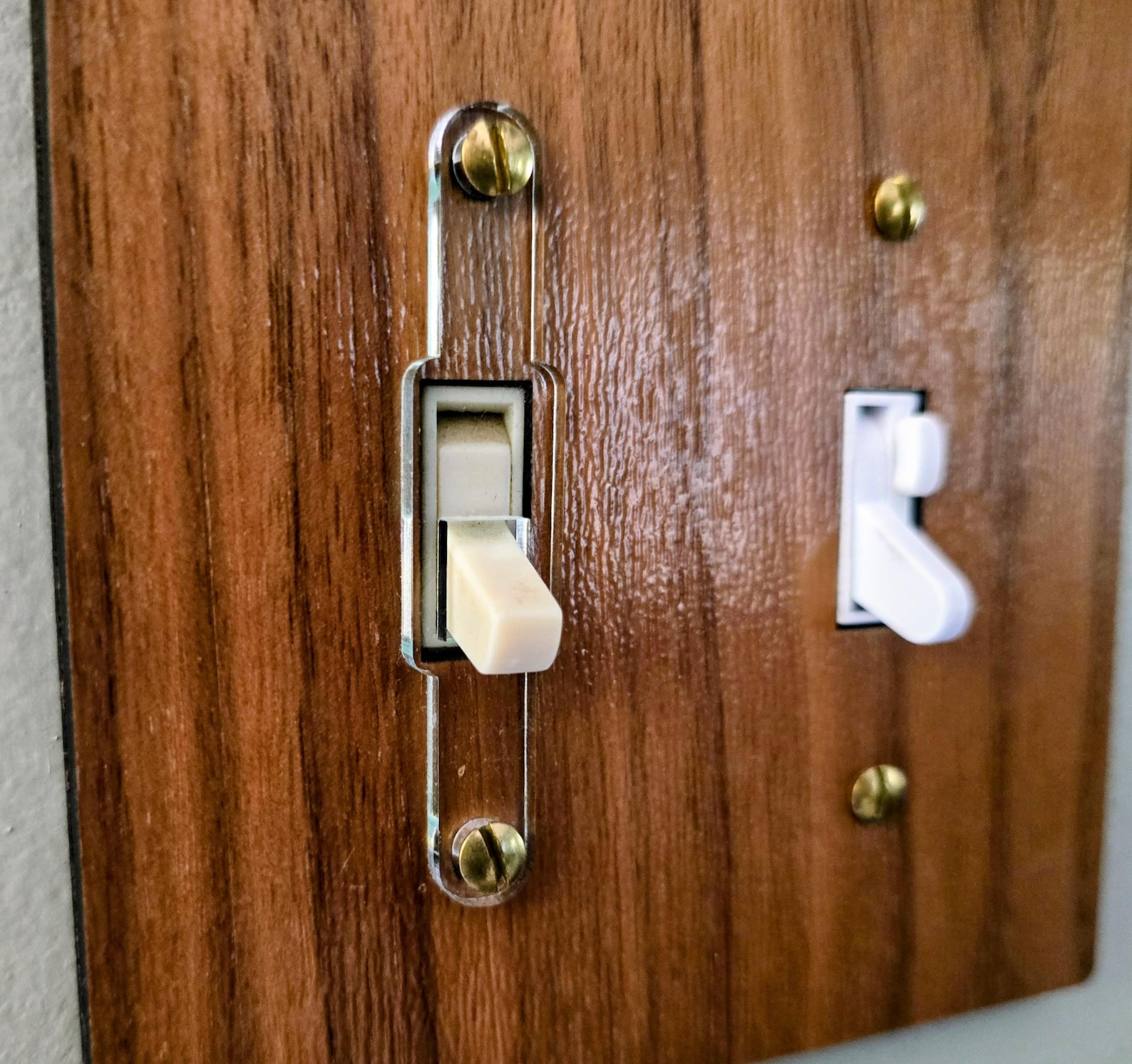
The whole idea: a small plate accessory mounts under the wall plate screw you already have and physically obstructs the toggle. No wiring, no new device, no electrician. One screwdriver, under a minute.
Which Switches Actually Need One
The pattern is always the same — a switch that controls something expensive or slow to recover, sitting somewhere a person can casually reach.
- Deep freezers and second refrigerators on a switched outlet. The classic. A few hundred dollars of food, and nothing to warn you.
- Sump and well pumps. The consequence of an off switch here is a flooded basement, and it shows up exactly when you were least paying attention.
- Aquariums and terrariums. Heaters, filters and lights on timers — livestock does not tolerate a weekend without them.
- Water heaters and garbage disposals. Both are frequently on unlabeled wall switches that look identical to a light.
- Outdoor and holiday lighting. Here you often want the opposite: locked off, so nobody powers a circuit you're mid-way through installing.
- Rentals, offices and shared spaces. Anywhere a "please do not turn off" note is currently doing the work of an actual object.
- Childproofing and pet-proofing. A toddler at switch height, or a cat that has learned the trick, both get bored quickly when the switch stops moving.
Three Designs, Three Different Jobs
Guards are not one shape. Which one you want depends almost entirely on how often you still need to use the switch.
| Design | How it mounts | Best for |
|---|---|---|
| Pivot Guard | Single plate screw; the tab swings down over the toggle and swings back up out of the way | A switch you occasionally need. Blocked by default, usable in a second without tools. |
| Lockout Bar | Both plate screws; a full-length bar holds the toggle solidly in position | A switch nobody should touch. The most secure of the three — defeating it needs a screwdriver. |
| Slide Guard | Low-profile cover that caps the toggle in your chosen position | Visible living spaces where you want minimum bulk sticking off the wall. |
Locking ON versus locking OFF
All three are reversible — the orientation you install them in decides which state gets held. Mount one way and the toggle is trapped up (locked ON); flip it and the toggle is trapped down (locked OFF).
Locked ON is the common case, and it's the one people search for: freezers, pumps, aquarium gear, anything whose failure mode is silent. Locked OFF earns its keep during work — a circuit you're rewiring, a garbage disposal in a house with small kids, a seasonal outdoor line you don't want energized until you're ready.
Not a lockout/tagout device. A switch guard stops an accidental flip. It is not rated safety equipment and it does not isolate a circuit. If someone is going to work on the wiring, lock out the breaker and follow a real procedure under OSHA 29 CFR 1910.147. Different problem, different hardware.
Wood or Acrylic
This choice is about whether you want the guard to disappear or to shout.
Wood is for switches in rooms people look at. Cut from the same veneered stock as our wood switch plates across 14 species — walnut, cherry, maple, African mahogany, sapele, red and white oak, birch, hickory, knotty pine, aromatic cedar, bamboo, clear alder, and paintable MDF — so a guard can match the plate it sits on and read as part of the trim rather than as an add-on. If you're picking a species cold, the 14-species guide shows what each one actually looks like on a wall, and the room-by-room guide covers what tends to work where.
Acrylic is for the opposite intent. On a basement, garage or shop switch, being conspicuous is the feature — a bright or patterned guard is a visual marker that says this switch is different before anyone's hand gets near it. Over 30 colors and patterns, from plain black, white and clear through green glass, glow-in-the-dark, camo, buffalo plaid, rainbow iridescent and rose gold mirror. Same finishes as the acrylic plates, so a guard and its plate can be a matched set.
Installing It
There is nothing electrical about this job. You never open the box, never touch a conductor, never see a wire.
- Back the wall plate screw out — just the one, or both for a Lockout Bar.
- Set the guard against the plate so its slot lines up with the screw hole.
- Decide your orientation now: tab over the top of the toggle to lock ON, over the bottom to lock OFF.
- Run the screw back in and stop at snug. Do not lean on it — wood and acrylic both dish under a screw head that keeps turning.
If your plate is a thicker stack, or the box sits recessed behind the wall, that added thickness eats into thread engagement and you may want a longer screw — the screw length guide covers the 1/2" versus 3/4" call. And if you're changing the plate at the same time, the whole plate job is also one screw.
Why Not Just Use Something Else?
Every alternative to a guard fails in a specific, predictable way.
| Approach | Why it doesn't hold |
|---|---|
| Tape over the switch | Peels, yellows, leaves adhesive on the plate, and is trivially removed by anyone determined to find the light switch. |
| A written label | Depends entirely on the person reading it before their hand moves. Most accidental flips are not deliberate decisions. |
| Clear plastic box covers | They work, but they're bulky, they yellow with age, and they look like industrial equipment bolted to a living room wall. |
| Removing the switch entirely | Real electrical work, permanent, and it takes away the ability to ever use the switch on purpose. |
| A smart switch | Solves it in software — until the app changes, the hub drops offline, or the firmware updates. A physical block has no firmware. |
What Fits, and What Doesn't
These guards are cut for a standard US single toggle switch — the small bat-handle lever that's been the American default for decades. That's what they block, and it's what most of these problem switches are.
They are not designed for rocker or Decora paddle switches, which present a broad flat face rather than a lever, nor for slider or rotary dimmers. If you're not sure what you've got on the wall, send a photo before ordering — it's a thirty-second answer.
Screw hole spacing is worth a thought in older houses too, since it hasn't always been consistent; how to measure switch plate screw holes walks through it.
The Short Version
- The fix for an accidentally flipped switch is a physical obstruction, not a label.
- Pivot Guard for a switch you still use; Lockout Bar for one nobody should touch; Slide Guard for minimum bulk.
- All three reverse — lock the toggle ON or OFF depending on which way you mount it.
- Wood to blend into a room, acrylic to stand out on a utility switch.
- Installs under the existing plate screw in under a minute. No wiring.
- It is not lockout/tagout. Servicing a circuit means locking the breaker, not the switch.
Frequently Asked Questions
Sources & References
- 29 CFR 1910.147 — The Control of Hazardous Energy (Lockout/Tagout) — OSHA (why a switch guard is not lockout hardware)
- Home Safety Guides — U.S. Consumer Product Safety Commission (childproofing context)
- Toggle Switch Guard, Laser Cut Wood or Acrylic — VARØ Industries on Etsy (the product described here: designs, materials, fitment)
- Laser Cut Wood Switch and Outlet Plates, Natural Hardwood Grain Covers — VARØ Industries on Etsy (matching plates, 14 species)
- Switch Plate Screws, Set of 8 — Ten Finishes — VARØ Industries on Etsy (matching plate hardware)
- Wood Switch Plate Sample Set — 14 Species Swatch Ring — VARØ Industries on Etsy (see and feel the species before choosing)
- How to Install a Wood Switch Plate (It's One Screw) — VARØ Industries Blog
- 1/2" or 3/4"? Screw Lengths for Switch and Outlet Plates — VARØ Industries Blog
- How to Measure Switch Plate Screw Holes for a Custom-Fit Cover — VARØ Industries Blog
- The 14 Wood Species Guide for Switch Plates — VARØ Industries Blog
- Which Wood Switch Plate Works in Which Room? — VARØ Industries Blog